Inhaltsverzeichnis
Conditional Sentences Type 1 – Bedingungssätze Typ 1
Mit if-Sätzen (Bedingungssätzen) sagst du, was passiert, falls eine Bedingung erfüllt ist. Beim Typ 1 ist die Bedingung gut möglich – sie kann wirklich eintreten. Auf dieser Seite lernst du, wie du solche Sätze bildest und worauf du achten musst.
(A) Was ist ein Bedingungssatz?
Ein Bedingungssatz (conditional sentence) besteht aus zwei Teilen:
- dem if-Satz (if-clause) [Nebensatz]: Er nennt die Bedingung. → Was muss passieren?
- dem Hauptsatz (main clause): Er nennt die Folge. → Was passiert dann?
(1) If it rains tomorrow, we will stay at home. [Falls es morgen regnet, bleiben wir zu Hause.]
(2) If Lily finds her ticket, she will come to the cinema with us. [Falls Lily ihre Karte findet, kommt sie mit uns ins Kino.]
(3) If you help me, I will finish my homework faster. [Falls du mir hilfst, werde ich mit meinen Hausaufgaben schneller fertig.]
(B) So bildest du Bedingungssätze Typ 1
if-Satz: if + simple present
Hauptsatz: will-future (will + Grundform des Verbs)
| if-Satz: simple present | Hauptsatz: will-future |
|---|---|
| If Karam plays well, | his team will win. |
| If we leave now, | we will catch the bus. |
| If Ruby studies hard, | she will pass the test. |
Im Hauptsatz kannst du auch die Kurzform verwenden: I’ll, you’ll, he’ll, she’ll, we’ll, they’ll (= I will, you will …).
Verneinung
- im if-Satz: don’t / doesn’t + Grundform
- im Hauptsatz: won’t (= will not) + Grundform
(4) If Tom doesn’t get up now, he will be late for school.
(5) If you eat all the sweets, you won’t be hungry for dinner.
(6) If it doesn’t rain, Maya and Sam will go swimming.
(C) Die Reihenfolge der Satzteile
Der if-Satz kann vorne oder hinten stehen. Die Bedeutung bleibt gleich.
(7) If Sherlock finds the key, he will open the door.
(8) Sherlock will open the door if he finds the key.
Komma-Regel:
- Steht der if-Satz vorne, setzt du nach dem if-Satz ein Komma → Beispiel (7).
- Steht der if-Satz hinten, setzt du kein Komma → Beispiel (8).
(D) Wann verwendest du Typ 1?
Du verwendest Bedingungssätze Typ 1, wenn etwas wirklich passieren kann. Oft sind das Pläne, Versprechen oder Warnungen.
(9) If the weather is nice on Saturday, we will have a barbecue. → Plan
(10) If you tidy up your room, I will give you some extra pocket money. → Versprechen
(11) If you touch the hot pan, you will burn your fingers. → Warnung
(E) Stolperfallen
1. Kein will im if-Satz!
Im if-Satz steht nie will, auch wenn es um die Zukunft geht. Du verwendest dort immer das simple present.
(12) If it will rain rains, we will stay at home.
(13) If Ryan will come comes to my party, I will be happy.
2. Das -s bei he, she, it
(14) If Lily find finds her phone, she will call you.
(15) If Sam don’t doesn’t hurry, he will miss the train.
3. if oder when?
Im Deutschen sagen wir oft „wenn“. Im Englischen musst du unterscheiden:
- if = falls → Es ist nicht sicher, ob es passiert.
- when = sobald → Es passiert sicher, die Frage ist nur, wann.
(16) If I see Tom, I’ll tell him. [Falls ich Tom sehe, sage ich es ihm.]
(17) When I get home, I’ll call you. [Sobald ich nach Hause komme, rufe ich dich an.]
4. Das Komma
Im Deutschen steht immer ein Komma zwischen Haupt- und Nebensatz. Im Englischen setzt du nur ein Komma, wenn der if-Satz vorne steht.
(18) We will play outside, if it is sunny. → We will play outside if it is sunny.
(F) Zusammenfassung
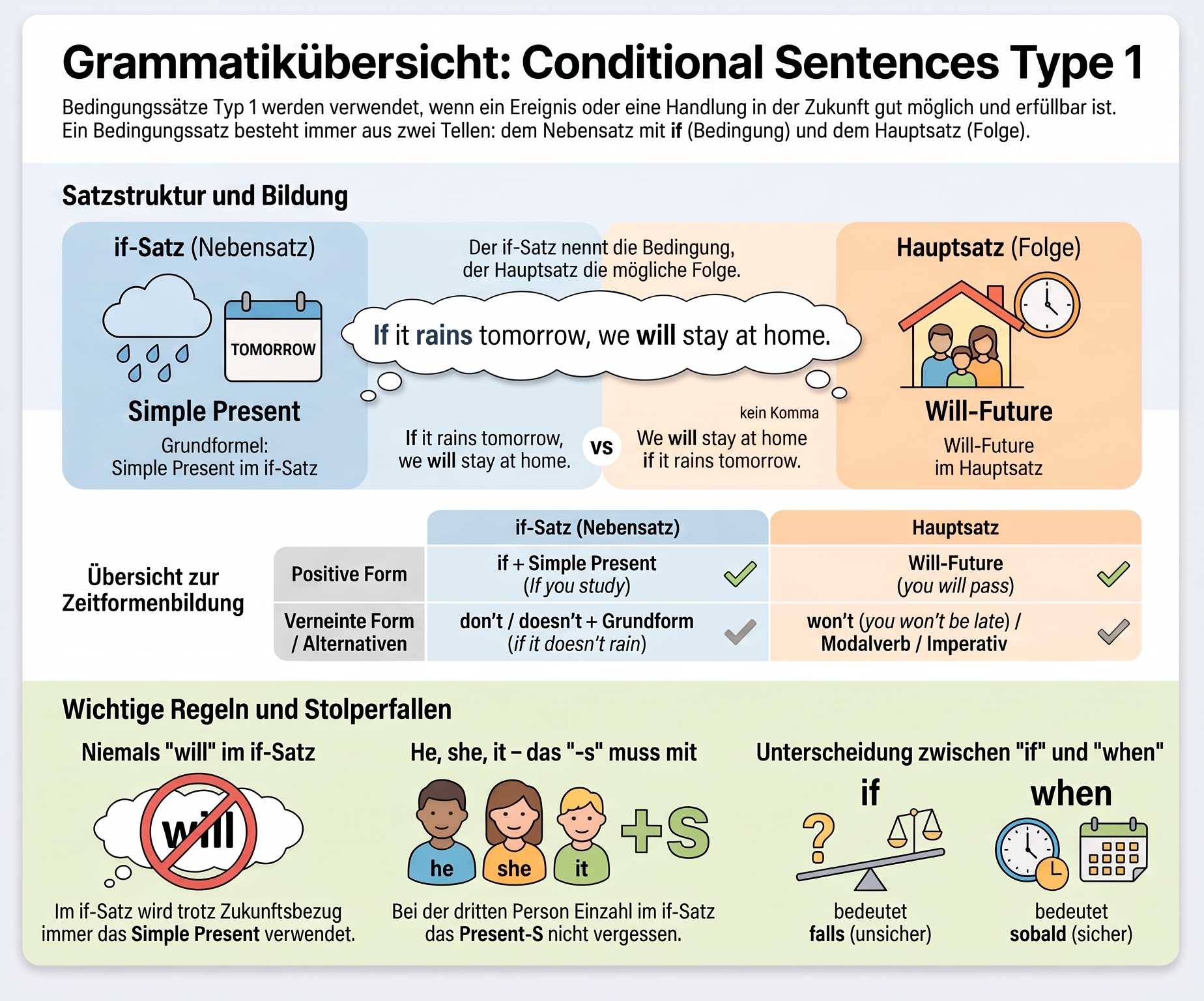
Bedingungssätze Typ 1 – das musst du wissen:
- if-Satz: if + simple present
- Hauptsatz: will / won’t + Grundform
- Typ 1 benutzt du für Dinge, die wirklich passieren können.
- Im if-Satz steht nie will.
- Denk an das -s bei he, she, it.
- Komma nur, wenn der if-Satz vorne steht.
- if = falls, when = sobald